- Home
- MRI vs. CT Scan: Which Imaging Test is Right for You?
MRI vs. CT Scan: Which Imaging Test is Right for You?
- March 13, 2026
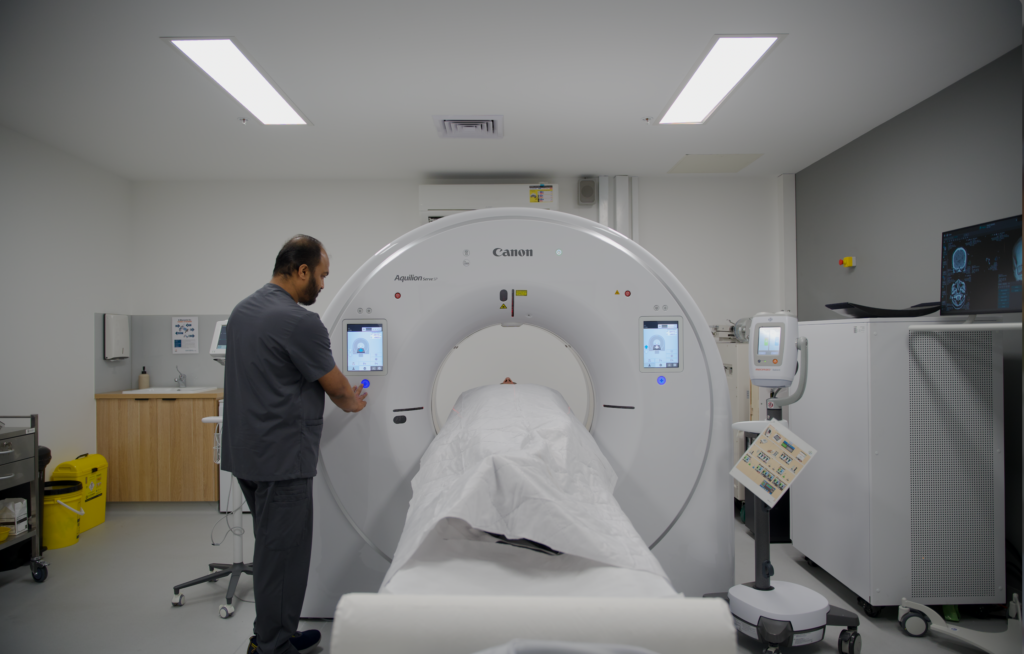
When your doctor recommends a medical imaging scan, you might hear terms like MRI and CT scan. Both are powerful diagnostic tools that provide detailed images of the inside of your body, but they work differently and are used for different purposes. Understanding the distinctions between them can help you feel more informed about your healthcare journey. At Scope Radiology in Clayton, Victoria, we offer both MRI and CT services, and our expert team can guide you on which is most appropriate for your specific condition.
MRI (Magnetic Resonance Imaging)
How it Works
MRI uses a strong magnetic field and radio waves to create detailed images of organs, soft tissues, bone, and virtually all other internal body structures. Unlike X-rays or CT scans, MRI does not use ionizing radiation. The magnetic field temporarily realigns hydrogen atoms in your body. Radio waves then cause these aligned atoms to produce faint signals, which are detected by the MRI scanner and converted into highly detailed cross-sectional images by a computer.
What it Shows Best
MRI is particularly adept at visualizing soft tissues. It is often the preferred choice for:
- Brain and Spinal Cord: Detecting tumors, strokes, aneurysms, multiple sclerosis, and spinal cord injuries.
- Joints and Musculoskeletal System: Diagnosing ligament tears, tendon injuries, cartilage damage, and bone infections (osteomyelitis).
- Abdominal and Pelvic Organs: Examining the liver, kidneys, pancreas, uterus, and ovaries for tumors, cysts, or other abnormalities.
- Breast Imaging: Used as a supplementary tool to mammography for breast cancer screening in high-risk women or for further evaluation of abnormalities.
- Blood Vessels (MRA – Magnetic Resonance Angiography): Assessing blood flow and detecting blockages or aneurysms without the need for X-ray radiation.
Key Considerations
- No Radiation: A significant advantage, especially for repeated scans or in children and pregnant women (though typically avoided in the first trimester).
- Longer Scan Time: MRI scans can take longer than CT scans, often ranging from 30 to 60 minutes or more.
- Noise and Enclosed Space: The MRI machine can be noisy, and the enclosed space can be challenging for claustrophobic patients. Earplugs or headphones are provided.
- Metal Restrictions: Due to the strong magnetic field, patients with certain metallic implants (e.g., pacemakers, some surgical clips, cochlear implants) cannot undergo an MRI.
CT (Computed Tomography) Scan
How it Works
CT scans use a series of X-ray beams taken from different angles around your body. These X-ray images are then processed by a computer to create detailed cross-sectional images, or “slices,” of bones, blood vessels, and soft tissues. CT scans are much faster than MRI and are excellent for visualizing bone structures and acute conditions.
What it Shows Best
CT is particularly useful for:
- Acute Trauma: Rapidly assessing internal injuries, bleeding, and bone fractures in emergency situations.
- Chest and Abdomen: Detecting lung diseases (e.g., pneumonia, emphysema, cancer), abdominal organ issues (e.g., appendicitis, kidney stones), and vascular conditions.
- Bone Imaging: Providing highly detailed images of complex bone fractures, spinal problems, and joint issues.
- Cancer Detection and Monitoring: Identifying tumors, assessing their size and spread, and monitoring response to treatment.
- CT Angiography (CTCA): Visualizing blood vessels, especially coronary arteries, to detect blockages or aneurysms.
Key Considerations
- Uses Ionizing Radiation: While the dose is kept as low as reasonably achievable, it does involve radiation exposure.
- Faster Scan Time: CT scans are generally much quicker than MRIs, often taking only 10-30 minutes.
- Less Sensitive to Movement: Better for patients who have difficulty remaining still.
- Metal Implants: Generally safe for patients with most metal implants, unlike MRI.
Which Scan is Right for You?
The choice between an MRI and a CT scan depends entirely on your symptoms, medical history, and what your doctor needs to visualize. Your referring doctor will determine the most appropriate imaging modality based on the clinical question. Here’s a general guide:
Feature | MRI (Magnetic Resonance Imaging) | CT Scan (Computed Tomography) |
Technology | Strong magnetic field and radio waves | X-rays |
Radiation | No ionizing radiation | Uses ionizing radiation |
Best For | Soft tissues (brain, spinal cord, ligaments, tendons, organs) | Bones, acute trauma, chest, abdomen, blood vessels |
Scan Time | Longer (30-60+ minutes) | Shorter (10-30 minutes) |
Noise | Noisy (earplugs provided) | Quieter (some whirring) |
Claustrophobia | Can be an issue for some patients | Less common due to wider opening |
Metal Implants | Restricted for certain implants (e.g., pacemakers) | Generally safe for most metal implants |
At Scope Radiology in Clayton, our Radiologists and experienced team will Aim to provide you receive the most appropriate and effective imaging for your diagnosis. We work closely with your referring doctor to provide accurate and timely results.
Frequently Asked Questions (FAQ)
Yes, in some cases, your doctor may request both an MRI and a CT scan to get a comprehensive view of your condition, as each modality provides different types of information.
Neither is inherently better; they are complementary. The best choice depends on what your doctor needs to see. MRI excels at soft tissue detail, while CT is faster and better for bone and acute trauma.
Please inform our staff when booking. We can discuss options such as providing eye masks, music, or in some cases, your doctor may prescribe a mild sedative to help you through the scan.
Modern CT scanners are designed to use the lowest possible radiation dose to achieve diagnostic quality images. The risk from a single CT scan is very small, and the benefits of an accurate diagnosis usually outweigh this minimal risk.
Our Radiologists will interpret your images and send a detailed report to your referring doctor, typically within 24-48 hours. Urgent findings are communicated to your doctor immediately.